The Leadership Problem DISC Actually Solves
Most leadership training teaches you what good leadership looks like. DISC does something different — it shows you what you look like as a leader, specifically how you communicate, make decisions, respond to pressure, and relate to people who think nothing like you do.
That gap — between knowing what good leadership is and actually practicing it — is where most managers get stuck. You can read every leadership book ever written and still walk out of a tense one-on-one having done exactly what you always do: talk too fast, go too quiet, push too hard, or avoid the hard conversation entirely.
DISC doesn't fix that overnight. But it gives you language for it. And language is where change starts.
Who Created the DISC Assessment?
Before getting into how DISC works for leaders, a quick bit of history that most articles get wrong.
DISC traces back to psychologist William Moulton Marston, who published Emotions of Normal People in 1928. Marston proposed that human behavior could be understood through four dimensions — Dominance, Inducement, Submission, and Compliance. He wasn't trying to build an assessment tool; he was developing a theory of human motivation.
The actual assessment instrument came later, primarily through the work of industrial psychologist Walter Clarke in the 1950s, who translated Marston's theory into a practical questionnaire format. From there, dozens of publishers built their own versions — which is why there are so many DISC assessment companies today offering variations of the same underlying model.
Worth noting: Marston is also the creator of Wonder Woman, which is either a delightful piece of trivia or a genuinely interesting clue about how he thought about personality, strength, and human potential. Make of that what you will.
The core model has stayed stable for nearly a century because it maps to something real in how people behave — not because it's scientifically perfect, but because it's practically useful. There's a difference.
What DISC Actually Measures
DISC is a behavioral assessment, not a personality test in the clinical sense. That distinction matters more than most people realize.
DISC assessment personality tests measure behavioral style — how you tend to act, communicate, and respond in your environment. They don't measure intelligence, values, emotional maturity, or potential. Someone can score high in Dominance and be a brilliant collaborative leader. Someone can score high in Compliance and be deeply creative. The profile is a starting point, not a verdict.
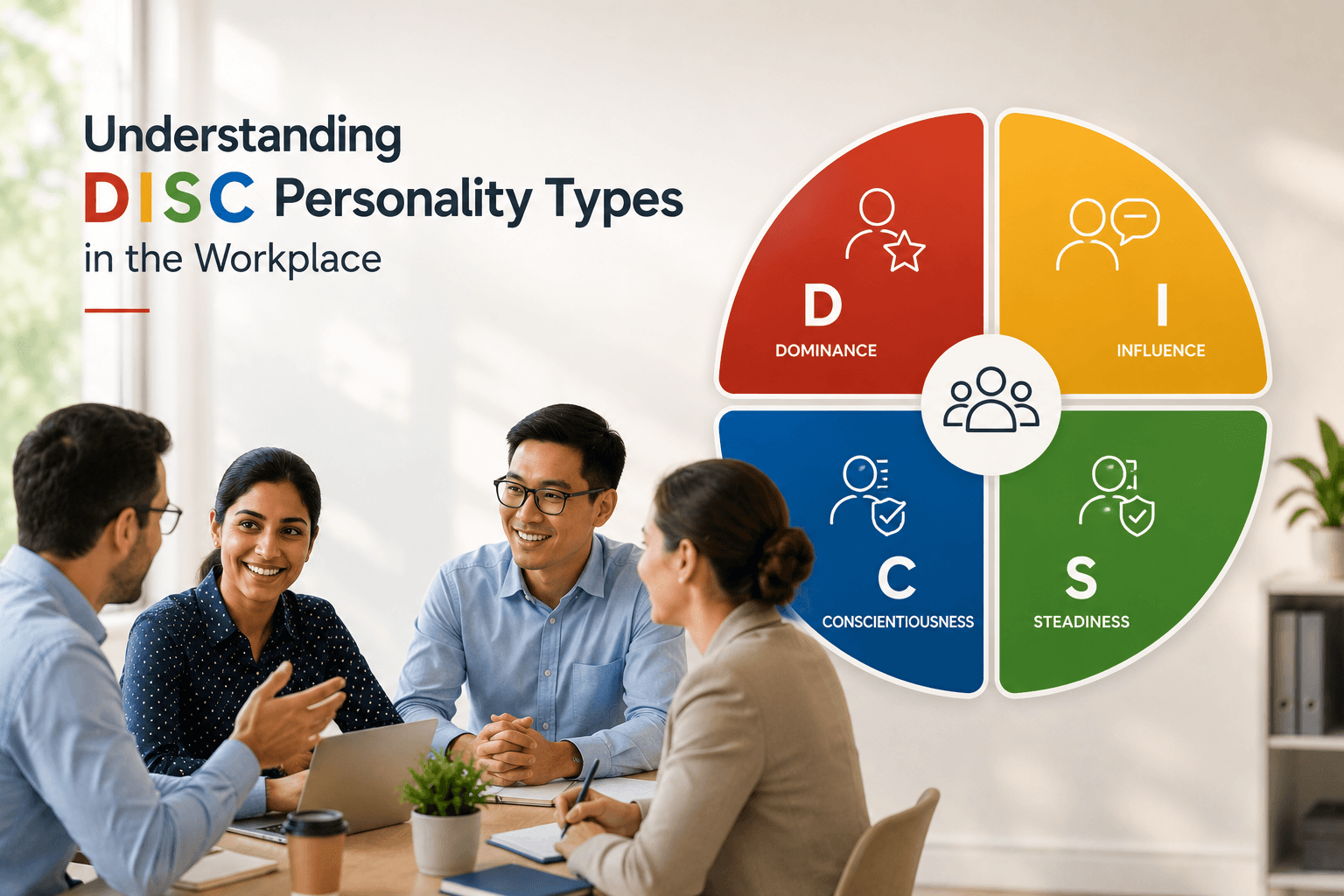
The Four Dimensions:
- D — Dominance: How you approach problems and challenges. High D people move fast, are direct, and don't love being managed closely. They can come across as blunt when they mean to be efficient.
- I — Influence: How you relate to and persuade others. High I people are expressive, enthusiastic, and relationship-oriented. They can struggle with follow-through when something stops being interesting.
- S — Steadiness: How you respond to pace and change. High S people are consistent, calm, and genuinely loyal. They resist sudden changes and can absorb a lot of stress before anyone notices.
- C — Conscientiousness: How you respond to rules and structure. High C people are analytical, precise, and quality-focused. They ask questions that other people find annoying and are usually right to ask them.
Most people have a blend of two or three dimensions that shows up across situations. The profile you get from a DISC assessment isn't a box — it's a map.
How Does DISC Help You Become a Better Leader?
Here's the honest answer: DISC helps you become a better leader by making your blind spots visible before they damage your relationships, your team's performance, or your own credibility.
Every leadership style has strengths that become weaknesses when overused. The high-D leader who moves fast and cuts through ambiguity starts micromanaging when they don't trust someone to execute. The high-I leader who builds great culture and pulls people together starts avoiding hard feedback when relationships feel at risk. The high-S leader who holds the team together under pressure starts bottlenecking decisions because change feels threatening. The high-C leader who catches every error and holds the team to standards starts paralyzing progress with perfectionism.
DISC doesn't tell you your leadership style is wrong. It tells you when you're overplaying it.
Four Ways DISC Makes You a More Effective Leader
1. It Changes How You Communicate — Not Just What You Say
The most immediate value of DISC for leaders isn't self-knowledge. It's other-knowledge.
Once you understand that your high-D direct report needs the conclusion first, not a five-minute context-setting preamble — and that your high-S team member needs time to process before they can respond meaningfully — your communication stops being a broadcast and starts being a conversation.
This isn't manipulation. It's translation. You're still saying the same thing. You're just saying it in a way the other person can actually receive.
Most communication failures in organizations aren't about dishonesty or incompetence. They're about people with different behavioral styles talking past each other in perfectly sincere ways. DISC gives you a framework to recognize what's happening and adjust.
2. It Helps You Understand Why Micromanaging Happens — and Stop
Micromanagement almost never starts as a control problem. It starts as an anxiety problem.
When a leader doesn't trust that something will get done the way they'd do it — because they don't understand how someone else works, or what motivates them, or how they process risk — the natural response is to get closer. Check more often. Ask more questions. Review the draft before it's ready.
DISC gives you a model for why your team members work the way they do, which reduces the anxiety that drives over-involvement. When you understand that your high-C team member needs to ask seventeen questions before they start because that's how they manage risk — and that they'll execute precisely once they've asked them — you stop interpreting the questions as stalling and start recognizing them as process.
Understanding behavioral style doesn't just build empathy. It builds the specific kind of trust that lets leaders actually delegate.
3. It Shows You Your Stress Behavior — Before Your Team Sees It First
Every DISC profile has what practitioners call a "mask" or "adapted style" — the version of yourself you show under normal conditions — and a "core style" — the version that shows up under pressure.
- For high-D leaders, stress often shows up as aggression or dismissiveness.
- For high-I leaders, it shows up as disorganization or people-pleasing at the expense of honesty.
- For high-S leaders, stress often looks like passive resistance or withdrawal.
- For high-C leaders, it shows up as analysis paralysis or hyper-criticism.
Here's the part most leaders don't want to hear: your team notices your stress behavior before you do. They've named it, probably. They've built workarounds for it. They know not to bring you certain topics on certain days.
A good DISC debrief doesn't just tell you your profile — it asks you what your team would say about you under pressure. The gap between what you think you're doing and what's actually landing is where the real leadership work happens.
4. It Gives You a Common Language for Team Dynamics
One of the least-discussed benefits of DISC is what happens when an entire team has taken the assessment and shared their results.
Suddenly the tension between two colleagues has a name. Suddenly the team understands why one person always slows things down with questions and another one keeps pushing forward before anyone's ready. Suddenly the conflict that felt personal starts to look like a behavioral difference that nobody chose.
That's not a small thing. Teams that understand each other's DISC profiles spend less time in interpersonal friction and more time in actual work. More importantly, they get better at flagging when someone's in stress mode — which builds the kind of psychological safety that lets teams work through hard problems without collateral damage.
What DISC Won't Do for Leaders
It's worth being honest about the limits, because overpromising is how useful tools become eye-roll moments in organizations.
- DISC won't tell you if someone is a good leader. Leadership effectiveness depends on values, judgment, experience, and context — none of which DISC measures. You can have a high-D profile and be an excellent collaborative leader. You can have a high-S profile and make bold calls under pressure. The profile isn't a prediction.
- DISC won't resolve deep trust issues. If a team has real broken trust — from a specific event, poor management history, or cultural problems — DISC is not the right starting point. Deal with the trust issue first.
- DISC won't replace difficult conversations. Some leaders use personality frameworks to avoid hard feedback. "Oh, that's just their DISC style" can become a way of excusing behavior that actually needs addressing. Behavioral insight is a reason to have a better conversation, not a reason to skip one.
Using DISC Specifically for Leadership Development
If you're using DISC in a leadership program — either your own development or someone else's — here's what actually moves the needle:
- Start with the leader's self-assessment, then add 360 data. A DISC profile on its own is one data point. When you pair it with how the leader thinks they come across versus how their team actually experiences them, the gap between the two becomes the most useful development conversation you'll have.
- Focus on the adapted style, not just the natural style. The profile leaders show at work is often different from their natural style. Pay attention to where the gap is large — that's usually where effort and energy are being spent on impression management rather than actual leadership.
- Make it practical, not theoretical. The worst DISC debriefs are the ones that spend an hour on the model and ten minutes on application. What specific situation does this leader keep getting wrong? What does their DISC profile tell us about why? What's one concrete thing they can try differently next week?
- Revisit it after six months. DISC profiles are not fixed. They shift as context shifts — new role, new team, high stress period, major organizational change. A one-time assessment with no follow-up is a missed opportunity.
DISC Assessment Personality Tests: How to Choose the Right One for Leadership Use
Not all DISC assessment personality tests are built the same, and the differences matter more for leadership development than for general team use.
Things worth checking before committing to a tool:
- Adaptive vs. static testing. Adaptive assessments adjust questions based on prior responses and tend to produce more reliable profiles. Static assessments give everyone the same question set regardless of how they've answered. For leadership development, reliability matters more.
- Depth of the leadership-specific reporting. Some DISC platforms offer leadership-specific modules that go beyond the standard behavioral profile — covering decision-making style, management approach, stress responses, and development areas. These are worth the extra cost for serious leadership work.
- Whether the tool is validated for development, not hiring. DISC assessment personality tests are not validated for pre-employment selection and most reputable vendors say so explicitly. If a vendor is selling you a DISC tool for hiring screening, look elsewhere.
- Report readability. If the report requires a certified specialist to interpret before anyone else can use it, ask yourself whether that's a feature or a bottleneck. For leaders who want to actually use their results — not just receive them — accessible reporting matters.
The Real Value of DISC for Leaders
The best thing a DISC assessment does for a leader isn't the four-letter profile at the end of the report. It's the moment — usually in the debrief — when they connect a pattern they've been living with for years to a behavioral tendency that finally has a name.
That recognition is where development actually starts. Not the aha moment itself, but what comes after it — the decision to show up differently in the next difficult conversation, to ask the question before jumping to the conclusion, to give someone else's process the room it needs instead of replacing it with your own.
DISC doesn't make great leaders. It makes leaders more aware of what they're actually doing. What they do with that awareness is the work.
This article draws on Marston's original work, practitioner experience with DISC-based leadership development, and publicly available research on behavioral assessments in organizational contexts.